Merger Control in 2011: A Statistical Study

Developments during 2011, statistics and their possible causes
In the last six years, the merger control analysis delay rate has greatly increased. For instance, while in 2005 the Antitrust Commission demanded an average of 4 months in order to analyze cases, by 2011 that rate has increased almost four fold.
Taking into consideration available public information such as the resolutions issued by the Argentine Antitrust Commission (the “Antitrust Commission”), during 2011 only thirty-two resolutions were issued, while the average delay rate was of 18 months.
All transactions demanded longer than twelve months, while twelve of them were reviewed for more than eighteen months. The transaction that took the most for the Antitrust Commission to analyze was under review for over thirty-eight months, being notified in January 2008 and approved in March 2011. (1)
Additionally, the Antitrust Commission has been active in monitoring economic transactions being entered and whether they must or must not be notified pursuant to the provisions of Antitrust Law. During 2011 the Antitrust Commission initiated several preliminary diligences in order to uncover non-notified transactions.
As such, it has also been active in the imposition of fines for lack or late notifications. Hence, Glaxosmithkline and Stiefel Laboratories were fined for Argentine Pesos 3,520,000 each (US Dollars 1,760,000) since they did not file an economic concentration in due time.
Regarding the types of resolutions that have been issued, out of those thirty-two cases that were analyzed throughout 2011, only six of them were subject to conditions, while none of them were rejected. These statistics on results fall in line with the historical rate of the Antitrust Commission: between 1999 and 2011 the Antitrust Commission issued 590 resolutions referred to merger control cases, out of which 90.51% were approved (534 cases), 8.31% were conditioned (49 cases) and 1.18% were rejected (7 cases).
As can be seen, most of the cases did not generate concerns from a merger control point of view, yet they demanded a long analysis timeframe. There are several factors that could be traced as probable causes to this significant delay:
(i) Increase in the number of transactions that require mandatory notification due to inflation issues
Considering that the notification threshold has not changed since the amendment of the Argentine Antitrust Law No. 25,156 (the “Antitrust Law”) in 1999, an increasing number of transactions have fallen under this scenario, since high inflation rates and increase of the value of other currencies with regards the Argentine Peso must be taken into account.
Bearing in mind that in the period between 1999 and 2001 the Argentine Peso was pegged to the US Dollar at 1, please find below a flowchart with the currency fluctuations for the 2002/2011 period:
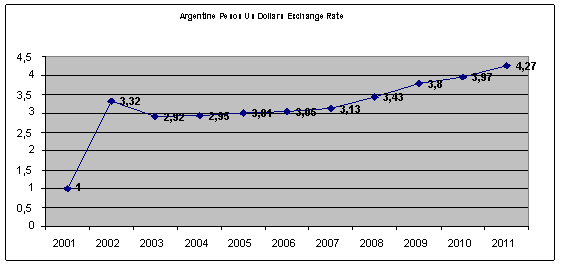
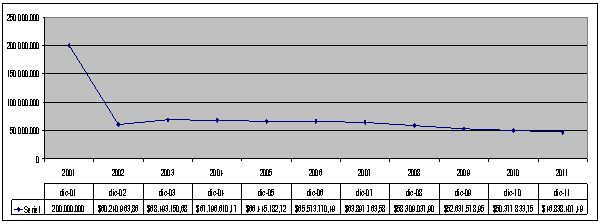
Based on the information provided in the flowchart above, it can be seen that as the Argentine Peso continued its currency exchange rate drop there was an increase in merger control notifications since the applicable threshold of Argentine Pesos 200,000,000 kept decreasing when being converted into US Dollars, as shown in the following chart:
(ii) Stop-the-clock policy
Section 13 of the Antitrust Law states that the Antitrust Commission shall have forty-five working days upon notification to resolve any transaction subject to merger control proceedings.
However, the Antitrust Commission has resorted to enforce a ‘stop-the-clock’ interpretation by means of which it considers that the first request for information stops the term of 45 business days, which will not start again until the necessary information for the issuance of the final resolution has been obtained from the parties. Although this interpretation has been subject to challenge before the courts, the Antitrust Commission continues to use it in the dockets.
(iii) Understaffing and prioritization
In the last few years, the increase of merger control cases has led to a downpour of cases for which the Antitrust Commission would need further resources. Additionally, recent steerage towards a greater interest on anticompetitive conducts investigation has also impacted on the speed of merger control analysis.
Conclusion
During 2011 the Antitrust Commission has continued its delay in the analysis of merger control proceedings. While the results show that there is a very low rejection rate, the increase in the analysis timeframe clearly points towards the need for an optimization of resources in order to avoid any unnecessary delay.
1. Resolution issued on March 21, 2011 in re. “Alto Palermo S.A. y otro s/ Notificación Artículo 8 Ley 25.156” (merger control docket No. 687).
This insight is a brief comment on legal news in Argentina; it does not purport to be an exhaustive analysis or to provide legal advice.


